
To commemorate India’s 79th Independence Day, Škoda Auto Volkswagen India Private Limited (SAVWIPL), in collaboration with the SaveLIFE Foundation, announced the successful completion of its two-year-long Zero Fatality Corridor (ZFC) programme on the Agra–Etawah–Chakeri stretch of National Highway 19 in Uttar Pradesh. This programme has been designed as part of the nationwide ‘Surakshit Sadkein, Surakshit Bharat’ initiative, which aims to reduce road crash fatalities and enhance overall road safety through structured, evidence-based interventions.
At the heart of this achievement lies SaveLIFE Foundation’s Zero Fatality Corridor approach, which has developed a replicable and scalable model to significantly bring down road crash deaths. The model functions on a comprehensive framework called the 4Es of road safety – Engineering, Emergency Care, Enforcement, and Education. By adopting this integrated approach, the project not only addressed immediate safety hazards but also laid the groundwork for sustainable, long-term improvements in road safety management.
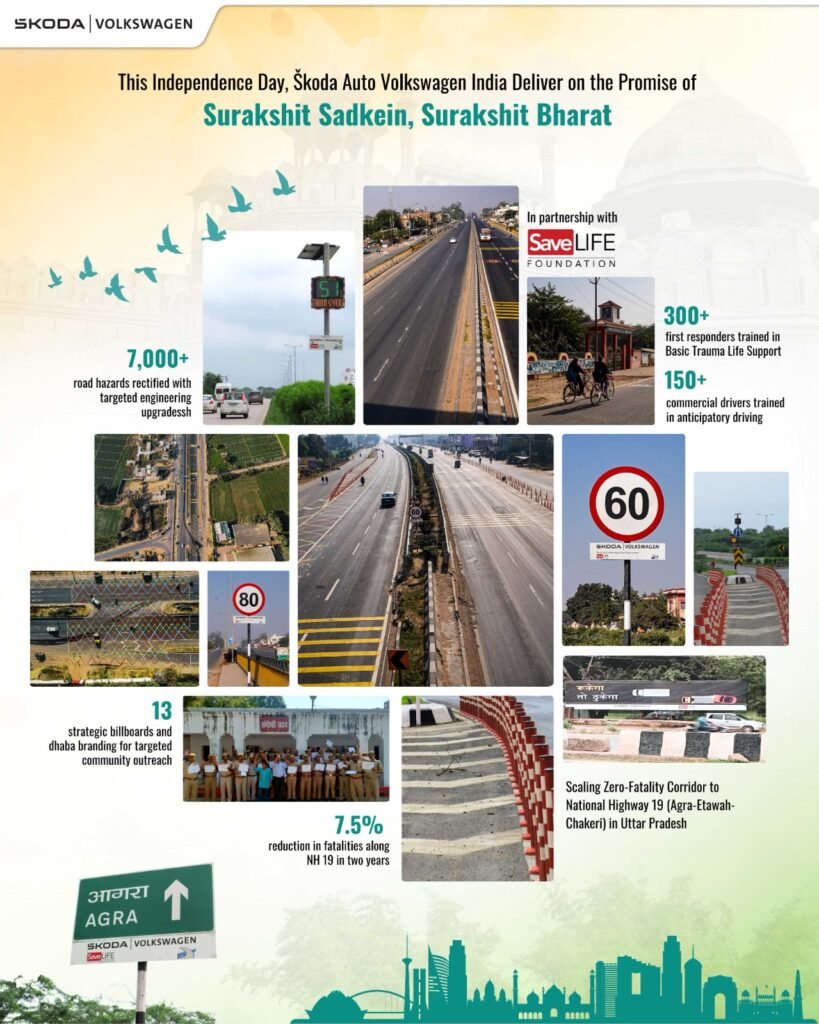
As a direct outcome of this initiative, road crash fatalities on this high-risk corridor have been reduced by 7.5% compared to the baseline year. More importantly, the programme has improved safety standards for an estimated 7.2 lakh commuters who travel along this crucial stretch of NH-19, ensuring a safer experience for both private and commercial road users.
Launch and Implementation
The ZFC programme was formally launched in November 2022, focusing on one of India’s most accident-prone corridors. The project deployed a range of engineering safety enhancements, alongside electronic enforcement systems, locally relevant and effective road signage, and the strengthening of trauma care facilities along the route.
One of the key factors behind the programme’s success has been the collaborative model of execution. The project team worked hand in hand with multiple stakeholders, including the National Highways Authority of India (NHAI), the Uttar Pradesh Police, the Transport Department, the State Road Safety Committee, and local administrative bodies. This collective effort ensured that safety improvements were not only well-designed but also effectively implemented, thereby creating a scalable proof of concept that can be replicated across other high-risk corridors in India.
Key Achievements of the Programme
The ZFC initiative has delivered measurable results, with several significant outcomes, including:

- Rectification of more than 7,000 engineering hazards from a total of over 16,000 safety risks identified along the corridor.
- Implementation of strategic safety upgrades such as installation of crash barriers, incorporation of speed-calming measures, and development of improved pedestrian facilities.
- Training of 300+ first responders in Basic Trauma Life Support (BTLS) to ensure timely and effective emergency medical response in the event of road crashes.
- Specialized training for 150+ commercial vehicle drivers in anticipatory driving techniques, enabling them to proactively identify and respond to potential hazards.
- Execution of impactful road safety awareness campaigns using outdoor media and local community outreach, including the installation of 13 strategically located billboards and branding at roadside dhabas to reach drivers and frequent highway users directly.
- Distribution of informative pamphlets in both Hindi and English, offering simple, easy-to-understand safety guidelines for commuters, particularly at redesigned intersections and vulnerable spots.
Impact and Future Scope
The Zero Fatality Corridor programme has demonstrated that road safety can be significantly enhanced through a multi-stakeholder, evidence-driven approach. By combining infrastructure upgrades, effective law enforcement, improved emergency response systems, and continuous public education, the initiative has proven to be a successful, scalable model.
The positive impact recorded along the Agra–Etawah–Chakeri corridor is expected to serve as a benchmark for road safety initiatives across the country. Moving forward, this programme is likely to inspire similar interventions on other high-risk stretches of India’s national and state highways, thereby contributing to the broader national goal of building ‘Surakshit Sadkein, Surakshit Bharat’ (Safe Roads, Safe India).