


The National Museum of Singapore stands as the island nation’s oldest cultural institution and a living chronicle of Singapore’s transformation. Its story begins in the mid-19th century as a modest repository of books, specimens and curiosities and grows into a 21st-century museum that blends Victorian architecture, cutting-edge design and immersive storytelling. Today the museum is both a guardian of national memory and an active place of learning, interpretation and public engagement.
This article traces its full arc: origins, architecture, collections, leadership, landmark dates, modernisation, notable exhibits, visitor information and the museum’s cultural role in Singapore.
Origins and early decades
The roots of the National Museum of Singapore trace back to the period when colonial Singapore was first building civic institutions. In the mid-1800s, collections of natural history specimens, maps, documents and books were gathered alongside the activities of the Singapore Institution and the Raffles Library.
By the 1880s those collections had outgrown their temporary quarters.
The colonial administration commissioned a purpose-built structure to house books and artifacts, and plans by the Colonial Engineer were finalised in 1882. The new building — executed in the Neo-Palladian, neoclassical idiom then favoured for civic buildings — was completed and formally opened on 12 October 1887.
It originally functioned as the Raffles Library and Museum and established Stamford Road as a cultural address
Architectural form and early expansions
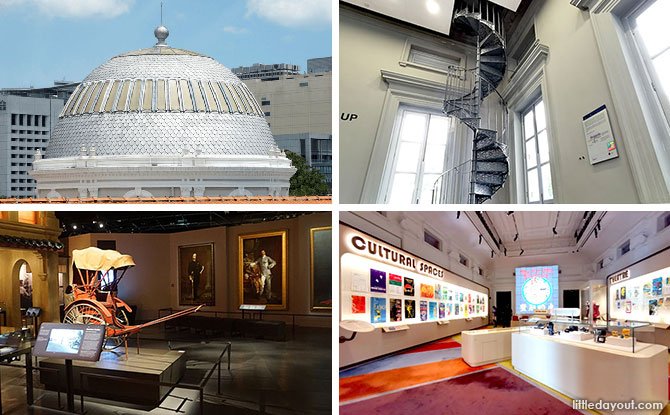
The original front block is a measured composition of pediments, pilasters and columned facades. Its symmetrical massing, classical proportions and a prominent zinc-tiled dome created a dignified civic presence.
As the museum’s collections and public role grew, the building expanded: a rear parallel block was added in the early 20th century (completed around 1906–1907) and a library wing followed in later decades.
Each expansion was handled with an eye to continuity, reproducing the classical vocabulary so that the whole retained stylistic coherence. Through the colonial and early modern periods the building served not only as a repository of objects but as a public forum for exhibitions, lectures and scholarly work.
Collection growth and curatorial priorities
From natural history specimens and ethnographic objects drawn from the Malay world to numismatic, geological and archival holdings, the museum’s collections grew rapidly in the late 19th and early 20th centuries.
Early curators and directors worked to catalogue flora and fauna, to document local vernacular cultures, and to acquire material that reflected regional history. By the early 1900s the museum had become an important regional repository for science and culture. Over time its focus evolved from a broad natural-history and scientific emphasis toward social history and nationhood — shifts that mirror wider institutional and political change.
Post-war transition and national identity
After the Second World War and into the post-independence era, the museum’s mission adjusted to foreground Singapore’s own story. With independence in 1965, there was a clear national impetus to collect, interpret and present the islands’ history, identity and cultural diversity.
Non-historical collections such as zoology were gradually transferred to specialist institutions and universities so the museum could concentrate on social memory, material culture and public history.
The institution was formally renamed the National Museum of Singapore in the latter half of the 20th century and continued to consolidate its holdings related to Singapore’s past and the wider region.
Legal recognition as heritage and landmark status
The National Museum of Singapore building and its site carry both historical and symbolic weight. It was officially designated a national monument in the early 1990s, a legal recognition that affirmed its value to the nation’s cultural patrimony.
That status guided subsequent conservation efforts, ensuring that any changes would be sensitive to the historic fabric and to the museum’s civic role.
A major turn: 2003–2006 restoration and expansion
The first decade of the 21st century marked one of the museum’s most radical transformations.

A lengthy and carefully planned redevelopment closed parts of the complex so that an ambitious project could restore heritage fabric, upgrade conservation and visitor infrastructure, and add a contemporary extension.
Architects and conservation teams sought to balance preservation with innovation: the result is a dialogue between the stately colonial blocks and a glass-and-metal annex crowned by a modern “Glass Rotunda” that echoes the original dome at a much larger scale.
The project rethought circulation, introduced climate control for sensitive collections, created new galleries and learning spaces, and embedded digital media for storytelling.
The revamped museum reopened to the public in December 2006 to great critical and popular acclaim, with renewed gallery narratives that placed Singapore’s history and living cultures at the centre.
Galleries, storytelling and national treasures
The museum organises its permanent displays around narrative-driven, visitor-centred galleries. The Singapore History Gallery guides visitors through pre-colonial beginnings, the colonial era, wartime occupation, the struggle for independence, and the city-state’s rapid modernisation.
Key objects anchor these stories: fragments of the ancient inscribed stone known as the Singapore Stone, the William Farquhar collection of 19th-century natural history drawings, early maps and documents, and a rotating selection of social artifacts that reveal everyday life across eras.
The museum has identified a set of national treasures within its collection that are both historically significant and emotionally resonant for Singaporeans.
Contemporary acquisitions and public memory
Beyond canonical artifacts, the National Museum of Singapore actively collects objects that speak to recent history and popular memory.
Examples include iconic airline seats and transportation artifacts linked to Singapore’s aviation history, archived signage and memorabilia from the city’s everyday life, and material that documents industrial, social and technological change.
The museum’s curators continuously acquire and interpret objects that reflect contemporary life, ensuring the collection remains a living archive rather than simply a historicist cabinet of curiosities.
Exhibitions, programming and community engagement
The National Museum of Singapore programs a mix of long-term galleries, temporary thematic exhibitions and public programmes. Exhibitions range from scholarly historical displays to imaginative, multimedia presentations designed to engage families, school groups and international visitors.

The museum also hosts film screenings, talks, performances, and educational workshops. Outreach and collaboration with community groups, schools and other cultural institutions help the museum widen its reach and relevance, bringing diverse perspectives into the national narrative.
Conservation, research and digitisation
As steward of fragile documents, textiles, works on paper and other sensitive items, the museum invests in conservation science and preventive care. Conservation labs, climate-controlled stores and professional conservation teams enable long-term preservation.
Parallel to physical care is a sustained effort to digitise collections and make curatorial data available for research and public access. Digitisation increases discoverability of objects and supports scholars, educators and a global audience.
Visitor experience and accessibility
The National Museum of Singapore is designed to be visitor-friendly: galleries are organised to tell coherent stories, interpretive labels are bilingual or multilingual where appropriate, tactile or audio materials make displays more accessible, and the architecture provides light-filled circulation routes and clear sightlines.

Practical visitor information — opening hours, ticketing policies (including concessions and free entry to certain groups), on-site amenities — is regularly updated by museum staff. The museum also strives for physical accessibility with ramps, lifts and trained front-of-house personnel.
Civic role and cultural impact
Across generations, the National Museum of Singapore has functioned as more than a repository; it has shaped national identity, informed civic memory and acted as a venue for public reflection.
Exhibitions marking anniversaries, moments of national debate, and community histories have helped Singaporeans reflect on the island’s past and future. The museum’s programs foster dialogue and encourage visitors to connect personal stories with larger historical forces.
Planning a visit: practical tips
Visitors should allow at least two hours for a meaningful walkthrough of the principal galleries; longer visits make room for temporary exhibitions and guided tours.
The museum’s central location in the civic district makes it easy to combine with other cultural sites. Check schedules for special exhibitions, family programmes and public tours, and consult the museum for any temporary closures or restoration work that may affect gallery access.
Looking forward: the museum in the present moment
Today the National Museum of Singapore balances its role as a national custodian with a dynamic, outward-looking public museum practice. It continues to conserve, collect and interpret while experimenting with new media, curatorial strategies and community partnerships.

The museum’s evolving exhibitions reflect current conversations about identity, migration, urban change and cultural memory, ensuring its relevance for future generations.
Conclusion
From its Victorian beginnings to its contemporary incarnation, the National Museum of Singapore has continuously reinvented itself while remaining faithful to its core mission: to preserve and present the stories that shape a nation.
Whether approached as architecture, archive, classroom or civic forum, the museum offers a comprehensive window into Singapore’s past, a platform for present reflection, and a resource for imagining the future.


